
Amidst the wave of technological iteration and energy-saving transformation in industrial kilns, high-temperature insulating ceramic fiber modules are emerging as the key core material driving kiln efficiency upgrades, thanks to their unique structural design and outstanding performance. These pre-compressed block units, made by folding and compressing ceramic fiber blankets, achieve higher high-temperature resistance limits through density enhancement. They not only significantly simplify the construction and lining renovation processes for industrial kilns but also fundamentally optimize their thermal performance, providing a breakthrough solution for energy conservation and cost reduction in the industrial sector.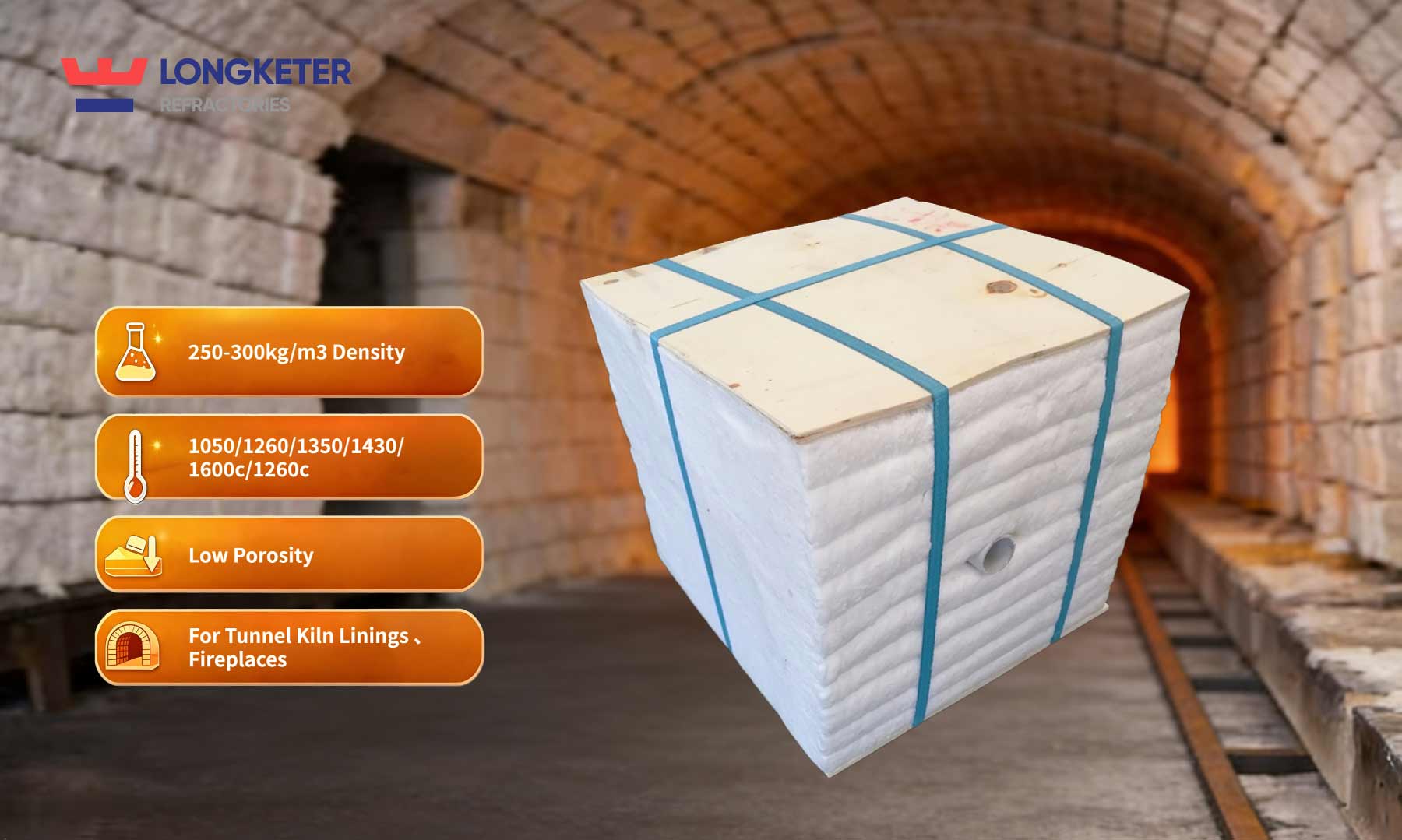 Core Advantages Highlighted: Upgraded Lining Performance Tailored for Industrial Kilns
The core competitiveness of ceramic fiber modules stems from the synergistic effect of their multiple performance advantages tailored to industrial kiln operating conditions. Upon unpacking, their folded layers expand tightly in all directions, forming a seamless kiln lining structure that prevents high-temperature heat leakage at the source. The elastic fiber blanket material endows them with excellent mechanical toughness, enabling them to easily withstand mechanical stresses during kiln operation and compensate for shell deformation, maintaining a seamless, insulated state over the long term and ensuring stable thermal efficiency of the kiln.
The lightweight characteristic is a key breakthrough for ceramic fiber modules in achieving industrial kiln energy savings—compared to traditional kiln insulation materials, they are lighter in weight and absorb minimal heat, allowing more energy to be precisely directed towards the production process. Concurrently, their excellent high-temperature insulation due to low thermal conductivity, superior thermal shock resistance, and the convenience of "install-and-start" (requiring no drying or curing) significantly reduce energy losses during kiln start-up, shutdown, and continuous operation. Notably, the scientific design of their anchoring system, which keeps it away from the hot face, effectively protects metal anchors from high-temperature erosion, extending the service life of industrial kiln equipment.
Driven by Technological Innovation: Reconstructing Industrial Kiln Construction and Energy-Saving Retrofit Models
The initial research and development of ceramic fiber modules aimed to simplify industrial kiln construction and improve lining integrity. Their practical application has led to a comprehensive innovation of traditional kiln technology. As a kiln hot-face material that can be directly exposed to flame, it integrates the three core functions of refractory, insulation, and energy savings into one unit, eliminating the need for multiple material layers, significantly streamlining the kiln's internal lining structure, and reducing the overall cost of kiln construction and retrofitting.
In the long-term use environments of industrial kilns, such as neutral, oxidizing, and weakly reducing atmospheres, ceramic fiber modules maintain good strength and flexibility. They are suitable for the complex working conditions of industrial kilns across various sectors including metallurgy, building materials, and chemicals. Widely applied in new construction and energy-saving retrofit projects for various industrial heating equipment, they are propelling kiln technology towards greater efficiency, lighter weight, longer service life, and lower energy consumption.
Precise Scenario Adaptation: Targeted Solutions for Energy-Saving Pain Points in Different Kiln Types
The energy-saving value of ceramic fiber modules can be precisely realized in different types of industrial kilns, offering targeted solutions to various heat loss challenges. For continuous industrial kilns, the heat storage process is completed once, and heat loss mainly originates from steady-state heat transfer. Appropriately increasing the thickness of the ceramic fiber lining can effectively reduce the kiln shell temperature and significantly cut steady-state heat loss. For intermittent (periodic) industrial kilns, the lining absorbs a large amount of heat in each operating cycle, where heat storage loss often exceeds steady-state loss. The extremely low thermal conductivity and lightweight nature of ceramic fiber modules become the core solution for reducing total heat loss, and energy-saving effects can be further enhanced by optimizing the furnace wall thickness.
Industry insiders point out that ceramic fiber modules, with their unparalleled technical and economic advantages, are gradually replacing traditional insulation materials, becoming the mainstream choice for energy efficiency upgrades and energy-saving retrofits of industrial kilns. Their widespread application not only promotes the green transformation of the kiln industry but also assists industrial enterprises in achieving dual improvements in energy utilization efficiency and production benefits, providing crucial support for the realization of the "dual carbon" goals in the industrial sector.


Get Price
Email:

Please feel free to submit your inquiry using the form provided below, and we will provide you with a quote within 24 hours.


