
In the demanding world of industrial thermal management, the quest for materials that offer both resilience and efficiency is relentless. Traditional refractory materials like brick or castables are often heavy, cumbersome to install, and prone to thermal shock. Enter the High-Temperature Needle Ceramic Fiber Blanket—a modern engineering marvel designed to meet the rigorous demands of furnaces, kilns, and boilers. With the capacity to withstand continuous exposure up to 1260℃ and a controlled density of 128Kg/m³, this advanced insulation material is setting new benchmarks for energy savings and operational safety .
This article delves into the technical specifications, diverse applications, and unbeatable advantages of using a 10-60 mm thick ceramic fiber blanket for your high-temperature equipment.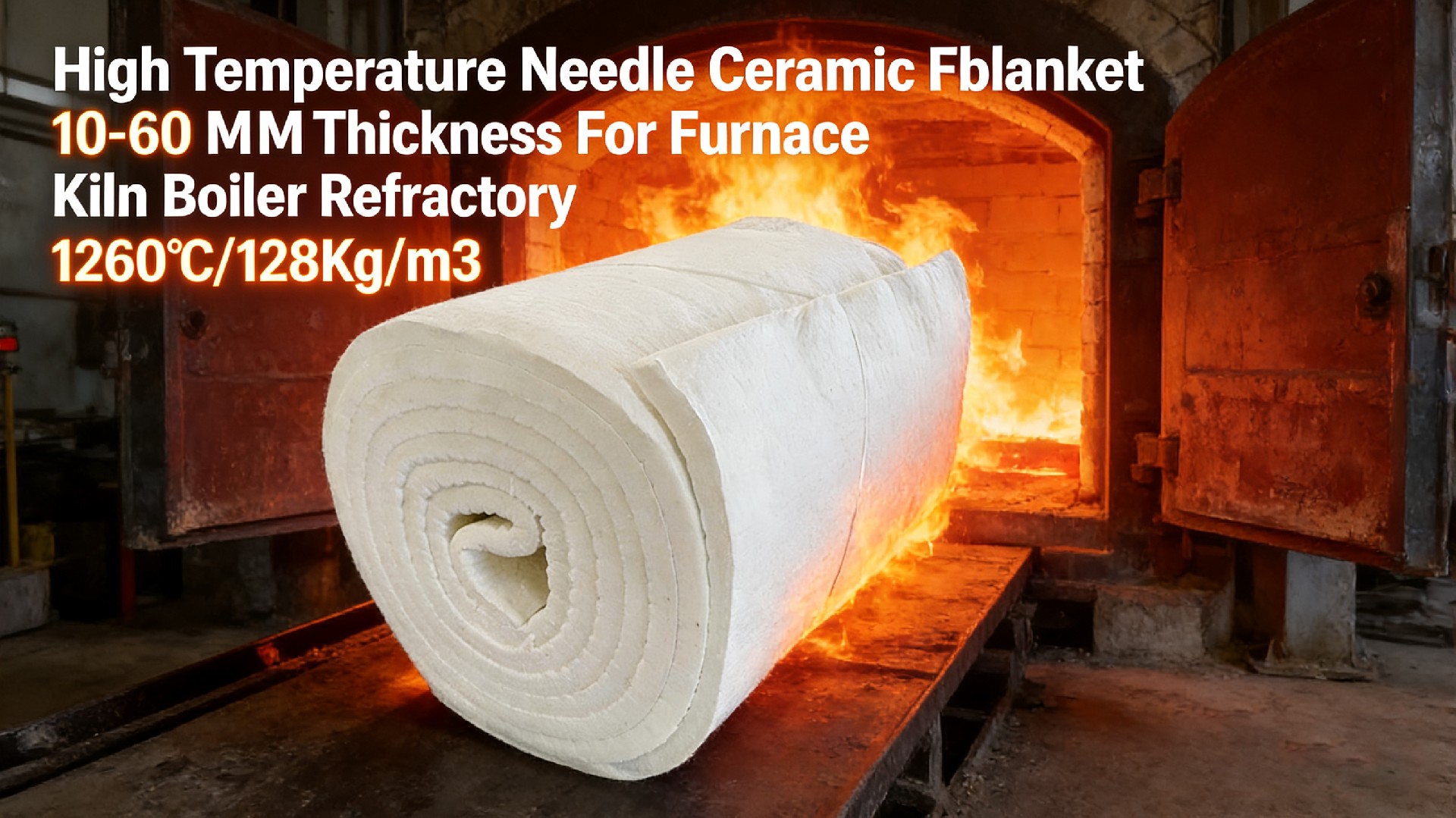
The core value of any refractory material lies in its ability to maintain structural integrity under extreme stress. The ceramic fiber blanket highlighted in recent industry analyses is manufactured through a sophisticated process involving the melting of high-purity raw materials like alumina and silica at extreme temperatures. This is followed by a needling process that entangles the fibers, creating a blanket with exceptional strength without the use of chemical binders .
Key performance data underscores its superiority:
Classification Temperature: 1260℃. This ensures reliable performance in high-heat environments where materials begin to degrade.
Density: 128 Kg/m³. This specific density strikes the perfect balance between lightweight properties and mechanical strength, ensuring the blanket is easy to handle while providing robust resistance to gas erosion .
Versatile Thickness: Ranging from 10 mm to 60 mm, this product allows engineers to customize thermal barriers based on specific heat flow calculations, optimizing both space and insulation effect.
Outdated refractory linings often lead to significant heat loss, slow production ramp-up times, and high maintenance costs. The adoption of a high-temperature needle blanket directly addresses these pain points through several inherent characteristics:
One of the most celebrated features of modern ceramic fiber blankets is their exceptionally low thermal conductivity and low heat storage . Unlike dense firebricks that absorb massive amounts of heat, fiber blankets reflect heat back into the combustion chamber. This means furnaces and kilns reach operating temperatures faster and require less fuel to maintain them. Recent field trials on continuous tunnel kilns lined with upgraded ceramic fiber have demonstrated reduced ramping time by 6-9%, directly translating to increased production capacity .
Industrial processes often involve rapid heating and cooling cycles. Traditional linings can crack under such thermal shock, but the flexible nature of the needle blanket allows it to expand and contract without damage. It offers excellent chemical stability and resistance to vibration, maintaining its integrity even in corrosive environments found in petrochemical cracking furnaces or steel reheating furnaces .
Beyond just heat retention, the fibrous structure of the 128kg/m³ blanket provides excellent sound absorption, reducing noise pollution from industrial operations
The versatility of the 10-60 mm thick ceramic fiber blanket makes it indispensable across various sectors. Whether you are insulating a boiler, lining a kiln, or repairing a furnace, this material adapts to the geometry of your equipment.
Ceramic Industry: Ideal for kiln car insulation, seals for continuous and batch kilns, and backup insulation behind dense refractory.
Steel Industry: Used in heat-treating furnaces, annealing furnace covers, ladle covers, and soaking pit seals to improve temperature uniformity .
Refining and Petrochemical: Applied in reformers, pyrolysis units, and high-temperature ducting to reduce fuel consumption by 4-7% in recent retrofits.
Power Generation: Essential for boiler insulation, expansion joint seals, and turbine insulation covers.
A key advantage of this product is its workability. It can be easily cut or fabricated on-site to fit complex piping and vessel contours. For large-scale industrial kilns, these blankets are often folded and compressed into ceramic fiber modules. When installed, these modules expand to form a seamless lining with no joints that could allow heat leakage.
When sourcing materials, experts advise looking for products with verified standards. High-quality blankets, such as those described in the image, ensure minimal shrinkage, consistent density (like the specified 128Kg/m³), and clear documentation of alumina content to guarantee the 1260℃ temperature rating.
As global industries push toward carbon neutrality and operational efficiency, upgrading insulation systems is a low-investment, high-return strategy. The High-Temperature Needle Ceramic Fiber Blanket (1260℃ / 128Kg/m³) represents the pinnacle of refractory technology. By choosing thicknesses ranging from 10 to 60 mm, industries can precisely engineer their thermal envelopes, ensuring that every joule of energy is utilized for production, not lost to the atmosphere.
For plant managers and procurement specialists looking to enhance performance and reduce overhead, this ceramic fiber solution is the clear path forward.


Get Price
Email:

Please feel free to submit your inquiry using the form provided below, and we will provide you with a quote within 24 hours.


