Can Long Keter Refractory Ceramic Fiber Boards Be Touched? Unveiling Safety Risks and Protection Gui
In industrial manufacturing and building thermal insulation sectors, refractory ceramic fiber boards have become indispensable high-temperature resistant materials, and Long Keter’s refractory ceramic fiber boards have emerged as a trusted option for numerous high-temperature scenarios thanks to their outstanding heat insulation and fire resistance. However, a common yet critical question has been raised among practitioners and end-users: is it safe to directly touch these boards? This question is closely tied to the material’s safety performance and the standardization of operation procedures.
Three Key Risks of Direct Contact with Refractory Ceramic Fiber Boards
Direct contact with unprotected refractory ceramic fiber boards may expose users to three major risks, which cannot be ignored:
·Physical scratch hazard: Even with surface finishing, conventional ceramic fiber boards may retain tiny burrs on edges and surfaces. Especially boards with imprecise cutting may have sharp edges that can easily scratch hands during handling and installation, causing skin damage.
·Fiber dust irritation: During production, cutting, and installation processes, ceramic fiber boards may release micron-level fiber dust. These fine particles can adhere to the skin, block pores, and trigger itching, redness, or rashes; people with sensitive skin may even experience skin tightness and discomfort after brief contact.
·High-temperature burn (the most dangerous risk): The core advantage of refractory ceramic fiber boards—high-temperature resistance—also hides an invisible hazard. For example, after shutting down an industrial kiln, the surface temperature of the installed boards can still reach hundreds of degrees Celsius. Bare-handed contact, even for a few seconds, can lead to severe burns, which is a frequent accident trigger in industrial sites.
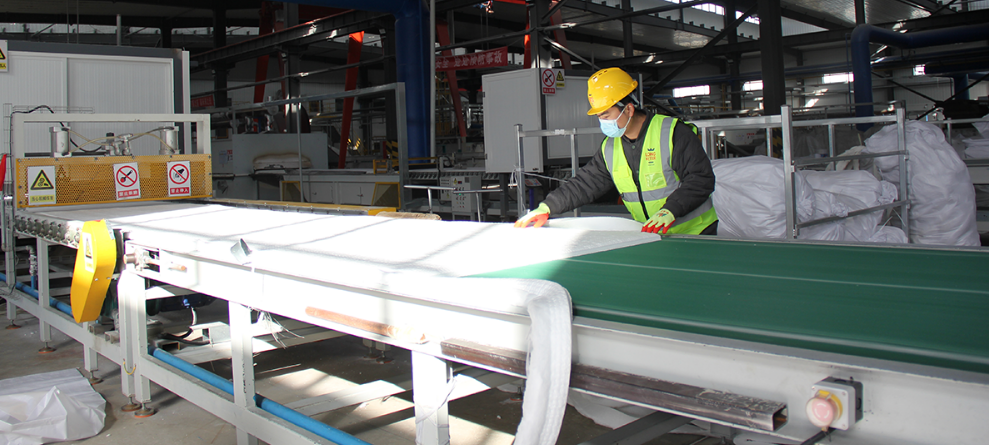
To address these safety concerns, Long Keter has optimized product craftsmanship through independent R&D, creating a safer product system:
·High-purity fiber molding process: We select low-impurity alumina-silicon raw materials and melt them at high temperatures in professional electric furnaces before spinning. This ensures uniform fiber diameter and smooth surface, fundamentally reducing burrs and scratch risks.
·Intelligent CNC precision cutting: All boards are cut by automated CNC equipment, with edge flatness error controlled within 0.5mm, eliminating hand injuries caused by rough edges during construction.
·Low-shot content control: Through three-stage slag removal and purification processes, the shot content in fibers is reduced to less than 3%, minimizing fiber dust emission and lowering irritation to skin and respiratory tracts.
·Composite surface protection: For building and household electrical scenarios, we have launched aluminum foil composite boards. The dense aluminum foil layer not only improves thermal insulation efficiency by 15% but also isolates direct contact between fibers and the human body, achieving double protection.
To further ensure user safety during application, Long Keter has formulated targeted operation norms:
·Temperature pre-check: Before any contact, use an infrared thermometer to confirm the board surface temperature is below 40℃ to avoid high-temperature burns.
·Industrial scenario protection: During kiln maintenance and equipment overhaul, operators must wear cut-resistant gloves and protective goggles; nitrile gloves are recommended for daily handling to prevent dust and scratches.
·Residential scenario tips: For uncoated boards in building insulation, wear nitrile gloves during contact; for aluminum foil composite boards, light contact is safe as long as the foil layer is intact.
·Post-operation cleaning: After installation or maintenance, wash hands thoroughly with mild detergent to remove residual fiber dust on the skin.
With over 18 years of experience in the high-temperature insulation material industry, Long Keter has been balancing product performance and user safety through continuous technological iteration and strict quality control, providing reliable solutions for high-temperature working environments.