
Driven by the global trend toward carbon neutrality and the steel industry's pursuit of ultimate energy efficiency, Zibo Long Keter New Materials Co., Ltd. has introduced a high-performance insulation ceramic rope that successfully addresses the issue of heat loss in walking beam heating furnaces. Operational data from multiple steel companies show that this innovative product can reduce heating furnace heat loss by 10%–12% while significantly extending maintenance cycles, marking a major breakthrough in high-temperature sealing technology.
As a core piece of equipment in steel production, walking beam heating furnaces operate with periodic temperature fluctuations in the range of 1,100–1,250°C. Sealing materials must continuously withstand severe thermal shocks and mechanical stress. Traditional fiber ropes often fail after just a few hundred thermal cycles, becoming brittle or powdery. Such sealing failures lead to significant heat leakage, increasing energy consumption and frequently causing equipment downtime, posing a bottleneck for the industry's green transition. This issue was highlighted at the 2025 China Steel Industry Furnace Ultimate Energy Efficiency Technology Exchange Conference.
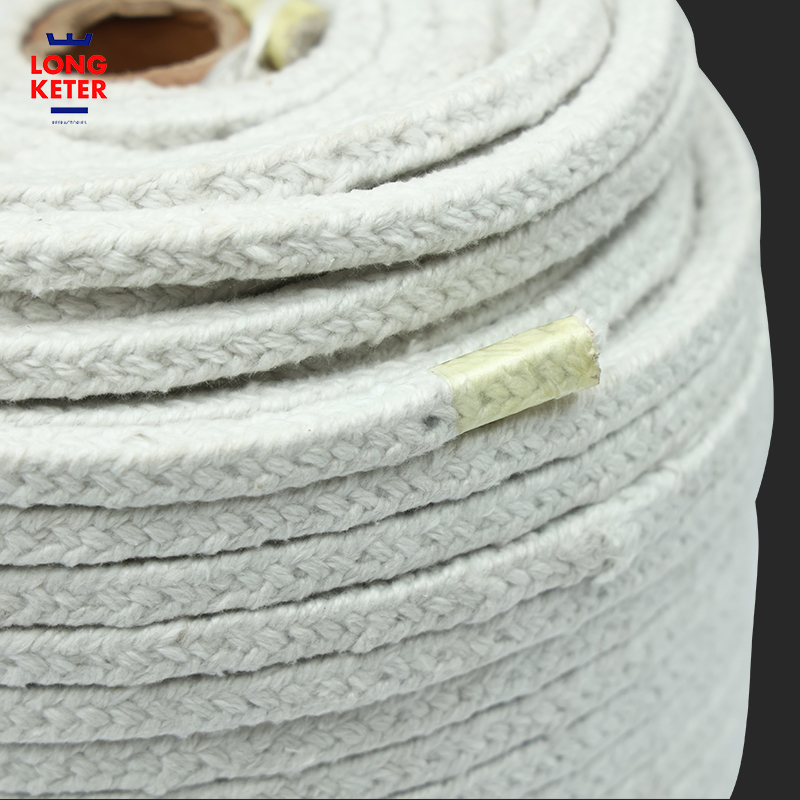
The Long Keter insulation ceramic rope is designed for extreme operating conditions, achieving performance breakthroughs through the combination of high-quality raw materials and advanced manufacturing techniques. The product uses high-purity alumina and silica sourced from the company's own mines, with impurity content stably controlled below 1%. The high-purity composition effectively resists crystallization reactions at high temperatures, fundamentally solving the brittleness and powdering issues caused by phase changes in traditional materials. "Strict raw material control ensures that our ceramic rope maintains good flexibility even after thousands of thermal cycles," explained a Long Keter R&D engineer.
Fiber precision further enhances the product's performance. Long Keter employs imported high-speed centrifuges (with a rotation speed of 11,000 rpm) to produce ultra-fine fibers with a uniform diameter (2–3 micrometers). These fine fibers form a dense network that rapidly disperses thermal stress, preventing localized fractures during rapid heating or cooling. Complementing this is the product's three-dimensional braided structure, which retains compressible and resilient space to absorb stresses caused by temperature changes and furnace door movements, ensuring that the sealing surface remains tightly fitted without deformation.
The stainless steel wire reinforcement layer incorporated during the braiding process significantly improves the product's tensile strength and wear resistance, preventing fraying issues even under prolonged thermal cycling. The entire production process is monitored by Long Keter's self-developed "Ceramic Fiber Product Intelligent Production Management System V1.0," which tracks key parameters such as twist, tension, and fiber distribution in real-time and automatically adjusts the process. This ensures consistent density, elasticity, and structural uniformity for every meter of ceramic rope—the core guarantee of reliability in industrial applications.
Practical application results confirm the product's value. A large steel enterprise in Hebei replaced traditional fiber rope with Long Keter ceramic rope on the heating furnace of its 2,300mm hot rolling line. Data after six months of operation showed an average decrease of 35°C in the furnace shell temperature, while the maintenance cycle for sealing components extended from two weeks to six months.
As the steel industry accelerates the adoption of green technologies such as waste heat recovery and clean combustion, reliable high-temperature sealing becomes increasingly critical. With an aluminum-silicon content of 98% and a maximum operating temperature of 1,260°C, Long Keter's insulation ceramic rope perfectly aligns with global sustainable development trends.
"Long Keter is committed to developing materials that fill performance gaps in high-temperature industrial applications," stated the company's CEO. "Our insulation ceramic rope not only reduces energy costs for enterprises but also supports the low-carbon transition of the steel industry—demonstrating that technological innovation can create both economic and environmental value."


Get Price
Email:

Please feel free to submit your inquiry using the form provided below, and we will provide you with a quote within 24 hours.


