
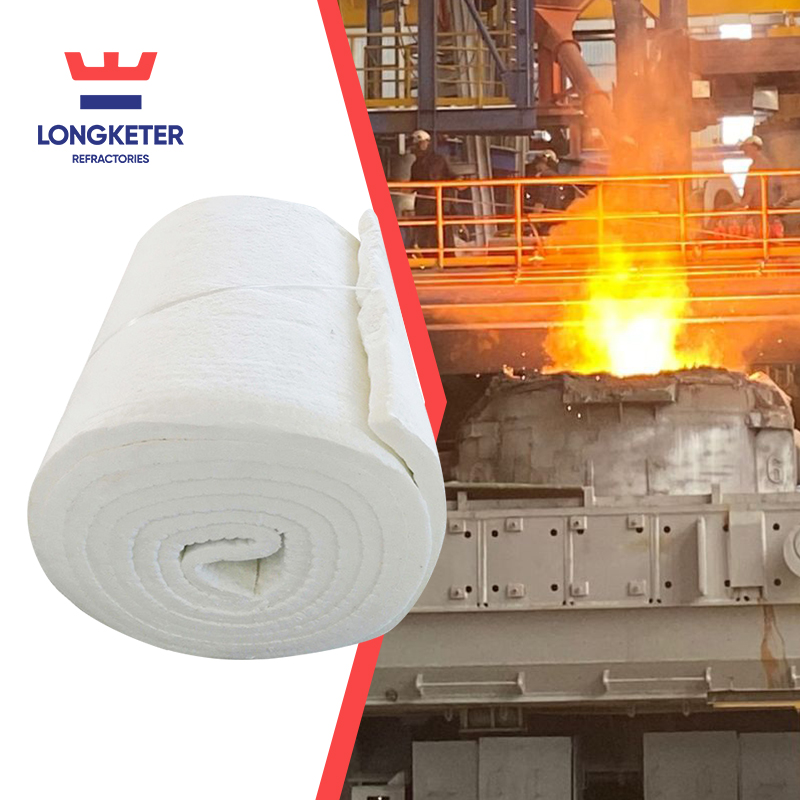
In steelmaking operations, the hot air ducts and recirculation flues of ladle preheaters need to operate continuously at temperatures of 600-1000°C (1112-1832°F), enduring repeated thermal expansion, airflow scouring, and vibration. These components are subjected to typical high-temperature fatigue conditions over the long term, whereas traditional ceramic fiber insulation blankets often face three core challenges in this environment:
Tearing and edge damage: Insufficient tensile strength makes them prone to cracking under frequent thermal and mechanical loads, especially in pipeline systems with significant vibration.
Thickness loss and structural loosening: Limited fiber toughness leads to compression, pulverization, or thinning, directly reducing insulation efficiency—industry data shows this issue accounts for 40%-50% of ladle heat loss causes.
Anchor loosening: The overall strength of the insulation blanket is insufficient to maintain structural stability in high-temperature environments, increasing maintenance frequency and unplanned downtime risks.
As a leading enterprise in China's high-temperature insulation materials field, LONG KETER systematically addresses these pain points through upgrades in fiber composition, spinning technology, and needling processes. Its ceramic fiber insulation blankets not only meet the stringent industry standards for high-temperature shrinkage rate and thermal conductivity in 2025 but also ensure long-term insulation stability for ladle preheater pipelines—aligning closely with the brand's mission of "making energy savings simpler."
How does LONG KETER enhance tensile strength and improve the long-term insulation stability of ladle preheaters?
Optimizing fiber structure—High-speed spinning technology delivers exceptional mechanical strength
LONG KETER employs advanced high-speed spinning technology to produce ceramic fibers that are finer, more uniform, and have a higher aspect ratio—a core innovation in the 2025 ceramic fiber industry iteration. This process creates two key advantages:
Higher intrinsic strength: Uniform fiber diameter (a hallmark of premium materials) with lower internal stress significantly enhances load-bearing capacity. The product's tensile strength can reach ≥0.06 MPa (surpassing most traditional products), maintaining stable performance even in cyclic high-temperature environments.
Stable three-dimensional fiber network: The tighter interweaving of fibers forms a robust structural skeleton. This microstructure effectively disperses mechanical stress, reducing fiber breakage and pulverization—critical for maintaining insulation thickness over the long term.
In practical applications, its tear and vibration resistance improves by 30% compared to standard insulation blankets, directly reducing heat loss and extending maintenance cycles.


Get Price
Email:

Please feel free to submit your inquiry using the form provided below, and we will provide you with a quote within 24 hours.


